
A summer holiday made for the mountains
Peak enjoyment
Summer holidays aren’t just about the coast. The mountains offer a different kind of escape, with winding roads, cooler air and space to slow down and explore. We’ve brought together a few simple tips to help you make the most of time spent at higher ground – among rustling spruce trees and the occasional whistling marmot. It’s a great way to enjoy summer in the California, whether the mountains are your main destination or a scenic stop along the way.
As you leave the flatter roads behind and head into the valleys, mountain roads open up to sweeping views of green pastures, craggy cliffs and snow‑tipped peaks. Travelling through the mountains is always memorable, and in the California it feels reassuringly relaxed. High‑torque engines take steady climbs in their stride, while available assist systems, such as Hill Descent Control, help give you added confidence on more challenging stretches. Pack just the essentials and you’ll not only enjoy the views, but also use less fuel as you make your way to your pitch.
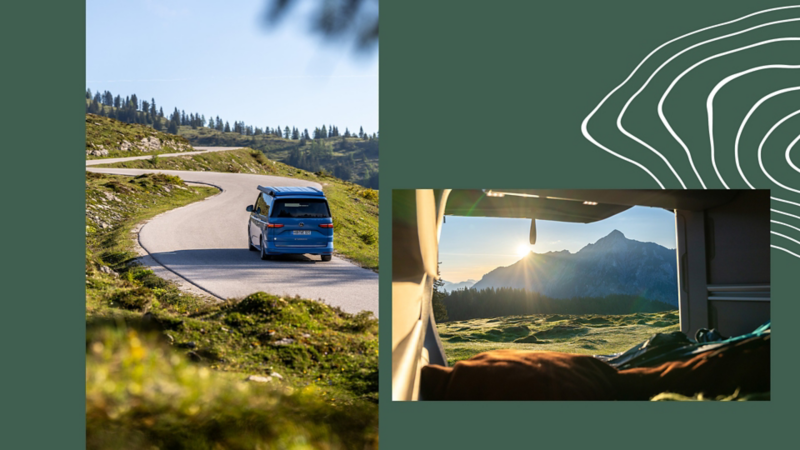
The Alps are home to a wealth of campsites.
Some mountain campsites offer a more luxurious stay, with organic shops, good restaurants and even wellness areas. In more remote regions, things tend to be simpler. You may find just a small pitch, sometimes without a power hook‑up, so it pays to plan ahead (which is easy with the California app) and decide whether a more self‑sufficient adventure is right for you. If it is, make sure the on‑board batteries are fully charged and consider solar panels or power banks to keep devices topped up. Fill your fresh water canister, empty waste water at a designated disposal point, and carry enough fuel and supplies for the journey ahead. Always use recognised campsites and avoid wild camping.

Whether you’re staying on a four‑star campsite or pitching up behind a barn on a working farm, mountain camping calls for a little more care than life on the flat. Weather can change quickly, with sunshine giving way to storms, hail or fog in a matter of minutes, and temperatures can drop sharply – even in summer. It’s not unusual for nights to dip below 10 °C in August, so a warm sleeping bag, extra blankets and thermal layers are well worth packing. Thermal window mats help keep the heat in, while, a levelling wedge is essential on uneven ground. After all, it’s not just sleeping that’s harder on a slope – cooking can be a challenge too.
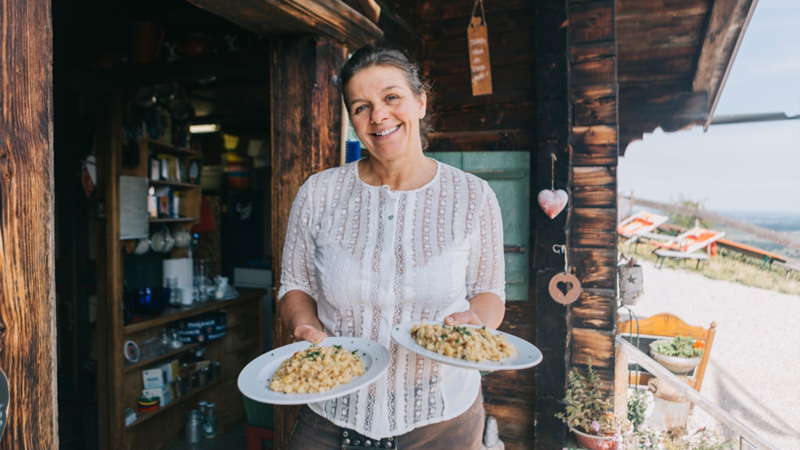
Cooking at camp can come with a few limitations in the mountains. During the summer months, many regions operate wildfire warnings, which can mean open flames are restricted or completely banned – including barbecues and camping stoves, even in designated areas. It’s always best to check what’s allowed with the site owner when you arrive. More often than not, you’ll be relying on the kitchen inside the California, or heading out to a local pub or restaurant. Thankfully, that’s no hardship. Europe’s mountain regions are rich in local food, from comforting classics like Kaiserschmarrn, Käsespätzle and Älplermagronen to regional specialities such as Slovakian halušky, Slovenian štruklji, Polish pierogi and South Tyrol’s tirtlan.
Heading up to the peaks?
Climbers will find no shortage of choice in Europe’s mountain regions. There’s a well‑trodden circuit in the Mont Blanc massif around Chamonix, while Italy is equally popular, with the Three Peaks in the Dolomites and Arco on Lake Garda attracting climbers year after year. Austria’s Kaiser Mountains and the Zillertal, along with Switzerland’s Bernese Oberland, are favourites for those who enjoy steeper challenges. For a quieter alternative, the Balkans are well worth a look. Albania, in particular, is emerging as an exciting climbing destination, yet remains refreshingly uncrowded. Areas such as the Korabi Mountains combine wild rock faces, unspoilt landscapes and a welcome lack of hustle and bustle.

Just because you prefer the water to the cliffs doesn’t mean you have to head to the sea: Europe’s mountain regions offer plenty of rewarding options for kayakers. Austria’s Lake Hallstatt, Slovenia’s Lake Bled and northern Italy’s lakes are ideal for calm, meditative paddling. Mountain rivers, on the other hand, are a draw for adrenaline seekers. As well as the Piave and Avisio in the Dolomites, Slovenia’s Soča is a standout, with its striking emerald‑green waters rushing through the Triglav Mountains towards the Adriatic. You can, of course, hire a kayak locally, but experienced white‑water paddlers may prefer to bring their own. With the right roof carrier, the new California can transport loads of up to 50 kg, making it easy to take your kit with you.
The easiest and maybe the most immersive way to experience the magic of the mountains? Hiking.
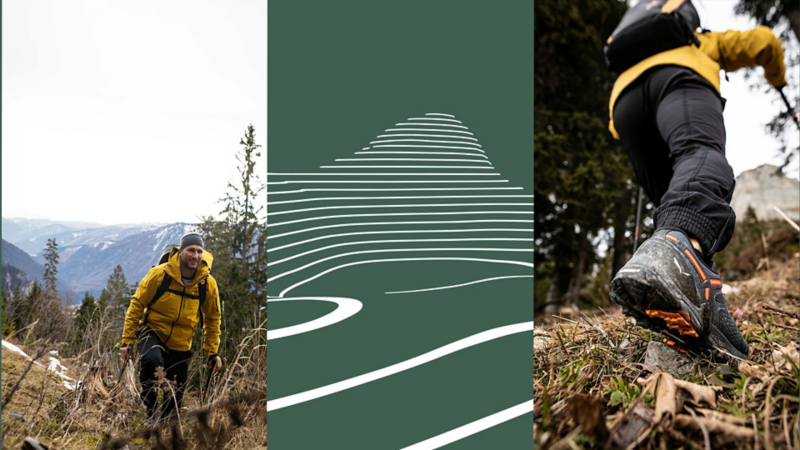
The Alps alone are home to more than 100,000 kilometres of marked paths, spread across thousands of routes. If you’re not planning a circular walk, or don’t fancy retracing your steps, a porter service can be a useful option. Local taxi and luggage services will transport your California across the mountains to meet you at the end of your hike. If you do set off on foot, it’s important to be well prepared. Make sure you’re carrying enough supplies and take extra care, as mobile phone reception can be patchy – or non‑existent – in the mountains. Download maps for offline use, take a paper backup, check the weather forecast before you leave and let someone know your plans.
And remember:
Not every mountain resident is quite as welcoming as the scenery. Alongside cows, chamois and the ever‑popular marmots, there are also wild boar and, in some regions, bears. Small bear populations can be found in parts of the eastern Alps, Italy and Slovenia, while the Carpathian and Tatra Mountains are well‑established bear territory. Slovakia alone is home to more than 1,000 brown bears. The good news is that bear encounters are rare. Making noise as you walk – talking or laughing with companions – usually gives wildlife plenty of warning and helps avoid surprises. Bears are naturally shy and will almost always move away before you see them. If you do encounter one, stay calm, avoid eye contact and back away slowly, giving it plenty of space. As with any mountain walk, being aware of your surroundings and following local guidance will help keep your time in the mountains both safe and enjoyable.


